Status: Verification Pending by Presenter
Please note that ToIP used Google NotebookLM to generate the following content and will update the status to “Verified by Presenter” accordingly.
Google NotebookLM Podcast
Here is a detailed briefing document reviewing the main themes and most important ideas or facts from the provided source, generated by Google’s NotebookLM:
A 42,000% Growth Spurt: 3 Radical Ideas from a New Creator-Governed Ecosystem
When a digital media ecosystem reports 42,000% year-over-year growth in viewership, it’s time to pay attention. The Open Commercial Media Ecosystem (OCME), a non-profit, members-based organization founded in 2024, is demonstrating a powerful new model for digital content. Its success isn’t just about numbers; it’s a direct response to a core industry problem. In a global creator market estimated at $205 billion in 2024, the relationship between creators and platforms remains fundamentally broken. Platforms exercise unilateral control over monetization, content policies, and account access, treating creators as users to be monetized, not partners to be empowered.
OCME proposes a new blueprint built on the principle of creator governance. We sat down with Executive Director Andy Woodruff’s recent deep-dive to extract the three core principles that make this ecosystem not just successful, but potentially revolutionary.
1. Beyond ‘Users’: Why Governing Your Content is the New Power Play
The first and most fundamental concept OCME introduces is the shift from User-Generated Content (UGC) to Creator-Governed Content (CGC). This isn’t just a change in terminology; it’s a fundamental restructuring of the power dynamics.
In the traditional UGC model:
- The platform owns your digital identity.
- The platform controls all policies, which can change at any time without your input.
- The platform sets revenue rates to benefit its shareholders, not the community.
In OCME’s CGC model:
- The user controls their own identity.
- Users, as voting members, participate in setting policies.
- Users set revenue rates through democratic processes to benefit stakeholders—the people creating the value.
This transition moves the creator from a passive participant, subject to the whims of an algorithm or corporate policy change, to an active governor of their own digital space. The philosophical foundation for this shift is captured perfectly in the principle of self-sovereign identity:
A person’s identity that is neither dependent on nor subject to any other power or state.
2. Rewriting the Rules of Revenue: Inside a Radically Fair Financial Model
OCME’s second game-changing idea is a financial model designed for maximum transparency and efficiency, ensuring more value flows directly to creators. Three innovations stand out:
- Clear Revenue Share: Creators receive 60% of gross revenue. This is a critical distinction. While platforms like YouTube and Spotify offer seemingly comparable rates, they are calculated from net revenue, after the platform has deducted its own costs. OCME’s top-line split is noticeably higher and far more transparent.
- Drastically Lower Fees: By using USDC stablecoins for global payments, the ecosystem slashes transaction fees from the 2-4% charged by traditional rails like Stripe or PayPal to mere “pennies.” The impact is substantial: for a creator earning $10,000 a month, avoiding those 2-4% fees means keeping an extra $5,000 a year that would otherwise vanish to middlemen.
- Eliminating ‘Black Box’ Funds: The presentation highlighted a major problem in the record label industry: “black box funds.” This is where an estimated one billion dollars in unclaimed royalties goes each year, money that labels often simply keep because they don’t know who to pay. OCME solves this by cryptographically linking every piece of content to its creator, ensuring that value can always be traced and paid out to its rightful owner.
These innovations are not isolated perks; they form a holistic financial engine. By combining a higher gross revenue share with radically lower transaction costs and guaranteed attribution, OCME ensures that value created by artists is not just recognized, but captured by them.
3. Pragmatism Over Purity: The Counterintuitive Genius of a Unified Ecosystem
In a world trending toward decentralized, interlocking systems, OCME makes a compelling case for a different approach: a single, unified, and hierarchical ecosystem. Instead of building an “ecosystem of ecosystems”—a flat, or “heterarchical,” structure where separate systems require transition layers and bridges—OCME has built one coherent framework containing different content verticals called “colonies” (e.g., music videos, gaming, news).
In an industry often obsessed with pure decentralization, OCME’s choice of a hierarchical model is a pragmatic masterstroke. It makes a deliberate trade-off, sacrificing architectural heterogeneity for a vastly superior creator experience—one identity, one ecosystem, zero friction. A creator joins the ecosystem once, receives one DID (digital identity), and can participate across any colony. Their identity, credentials, and reputation are seamless and portable throughout the entire system, putting the creator’s experience first.
Conclusion: The Future is Governed by Creators
Together, these three takeaways—creator governance, financial transparency, and a unified architecture—present a cohesive vision for a more equitable and efficient creator economy. This is no longer just a theory. With 600 members having already registered over 6,900 pieces of content, OCME has demonstrated a working, scalable model that is attracting creators at an astonishing rate.
The platform has moved beyond simply giving creators a space to upload content; it’s giving them the tools to build and govern their own digital destiny. This raises a final, exciting question: As creators gain more power to shape their own ecosystems, what new forms of collaboration and content will they build that we can’t even imagine today?
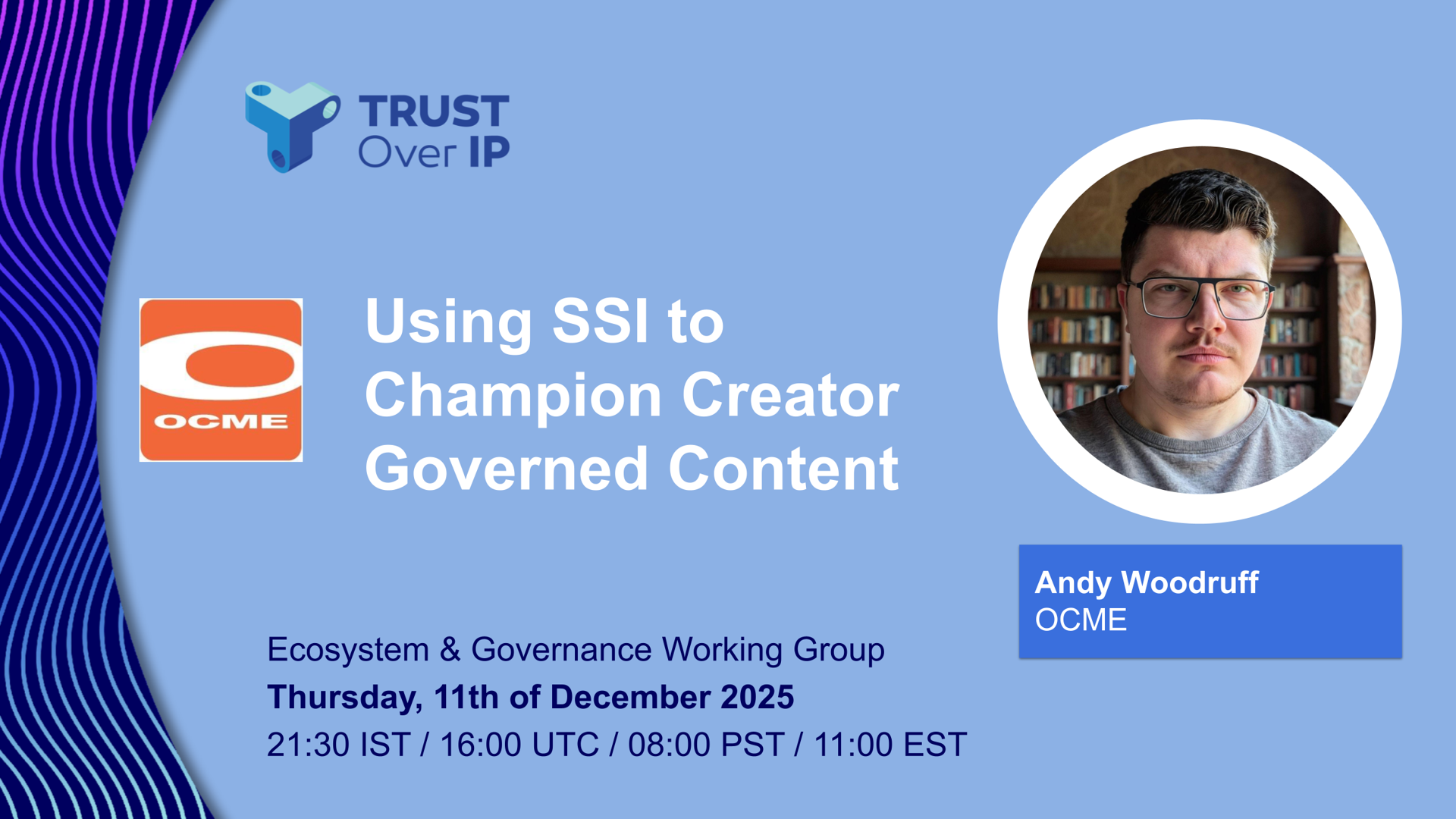
For more details, including the slides, meeting recording and transcript, please see our wiki 2025-12-11 Andy Woodruff and Using SSI to Champion Creator Governed Content